



 9 / 16

LE ROY PENNYSAVER & NEWS - DECEMBER 25, 2016
Fireworks
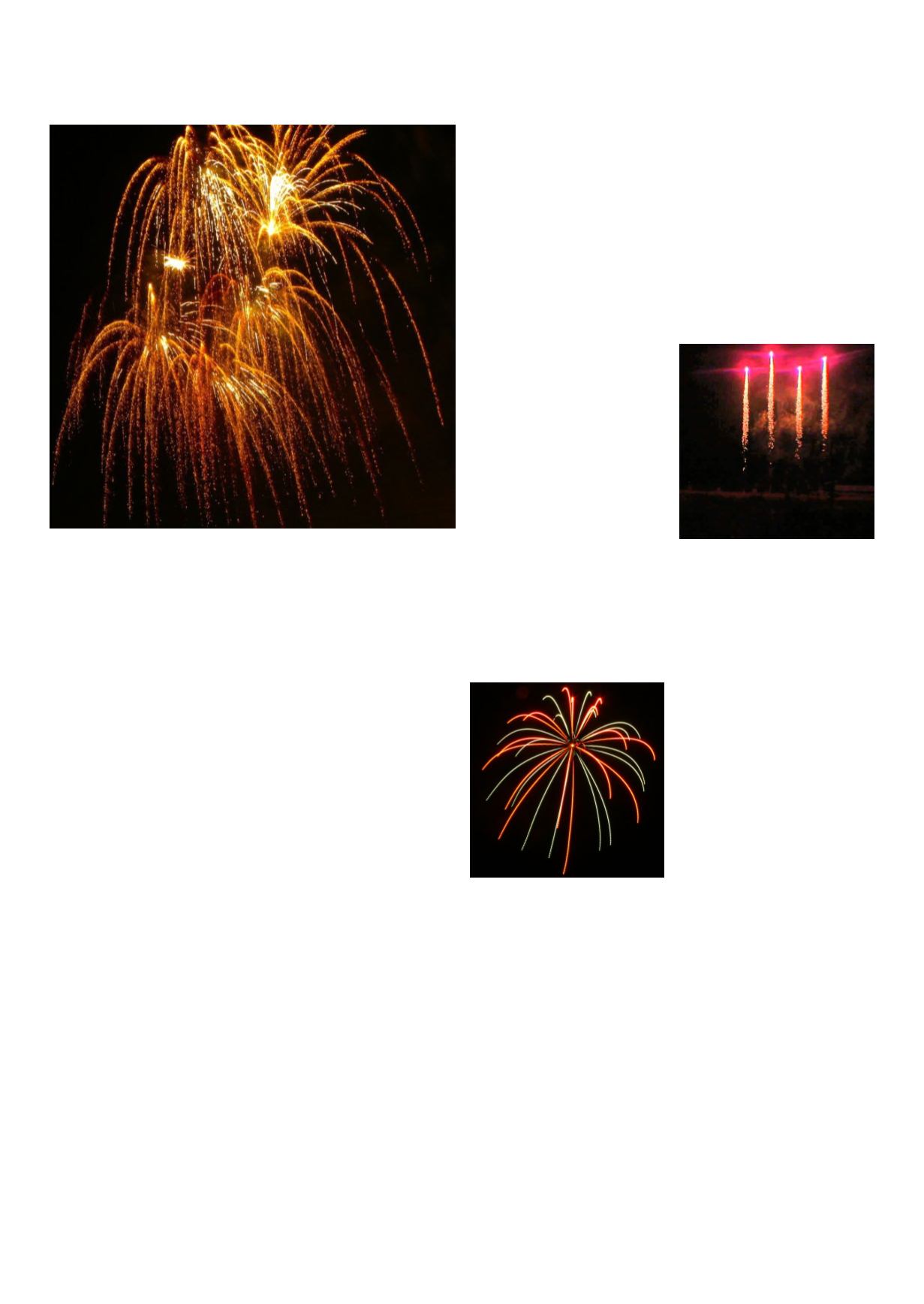
Aerial Shell- "Willow"
Stop by LeRoy House
on New Year’s Eve and stay
warm until the fireworks at 9.
The House opens at 7 pm and
there’s plenty of parking in
our parking lot. Last year folks
seemed to enjoy sitting by the
fire and playing with the old
fashioned games. The crinkinole
board will be set up as well as
all four skittles’ boxes. We’ll
see who can get high points. If
you just want to sit and listen to
the music box, it will be set up
in the back parlor. Last year, at
9, many of us stood on the front
porch and had a great view of
the fireworks.
Growing up, I never
enjoyed fireworks. I remember
driving out Scottsville Road and
parking near the old golf driv-
ing park to watch fireworks on
the Fourth of July, but I always
had my hands over my ears. It
wasn’t until Shelley Stein and I
were invited out to Canandaigua
to see a fireworks show by
Youngs Explosives that I really
got interested in fireworks. We
were given a “menu” of all the
fireworks that were going to
be shot off. Then we watched
“brocades”, “peonies,” and “wa-
terfalls” in all sizes and colors.
The menu listed a 6 inch, 8
inch, and 10 inch red brocade
and the price for each one. Then
there would be a “waterfall” in
various sizes and the prices. If
you wanted to put together a
fireworks show, and had a cer-
tain budget, you could take 3
from column one and 4 from
column two, and 2 eight inch
peonies and 2 six inch peonies
- - well you get the idea. Some
of the fireworks were imported
but many of the special effects
were made by Youngs. I have
to admit, that’s not a vocation I
would aspire to.
There is a lot of chem-
istry to fireworks. The colors
are produced by heating metal
salts. Sodium nitrate produces
yellow. Calcium nitrate pro-
duces orange, Barium salts
produce green. Purple is pro-
duced by a combination of
copper and strontium salts.
White is produced by aluminum,
titanium or magnesium. Blue
is produced by copper salts.
The colors are dependent on
the amount of energy released
by each element which is
characterized by a particular
wavelength. Lower energy
salts produce longer wavelength
light, in the orange and red spec-
trum. These salts are mixed with
binders and other chemicals
and rolled into small clay balls
which are placed inside the
shell. When these explode they
are called “stars.” The shells
are propelled into the air by
the combustion of black pow-
der, which is a combination of
potassium nitrate, charcoal and
sulfur. This concoction was said
to have been first used in Chi-
na over 1000 years ago. The
fuse carries the flame to the lift
charge of black powder. At the
same time a delay fuse is ignited
that will work it’s way up to the
shell. If everything goes right,
the lift charge will take the shell
high into the air, and the delay
fuse will ignite the shell when
it reaches it’s highest point. (I
learned that Disney World has
tried using compressed air to
propel the shells into the air, in
an effort to reduce the smoke
from the black powder. In fact,
Disney is the largest client of the
fireworks industry. Apparent-
ly, the cost of the compressed
air system and other problems,
have forced Disney to curtail
this process, in all their park,
with the exception of Disney-
land in California.)
Aerial shells are the
most common type of firework.
These include a shell filled with
“stars” and a cylinder filled with
black powder which propels
the shell into the air. The most
common aerial shell is a “peo-
ny.” “Chrysanthemums” are
like peonies, but the stars leave
visible trails. “Dahlias” are like
peonies with fewer stars, but
the stars are larger and trav-
el further from the shell break
before burning out. “Willows
are similar” to the chrysanthe-
mum, but have long burning
silver or gold stars that produce
a weeping willow-like effect.
Diadems are chrysanthemums
or peonies with a center cluster
of non-moving stars of a con-
trasting color. Spiders contain
a fast-burning tailed star that
bursts very hard and propels
the stars in a straight line before
falling. One of my favorites is
a brocade, which gives a spi-
der-like effect, much like fine
lace and it is brighter than the
willow.
Comets
are
aeri-
al shells that are ignited and
launched into the air and burn
with a bright color as they as-
cend to their maximum height.
They do not “burst” or “break,”
rather they have a tail. Com-
ets are usually used during the
playing of the National Anthem
- - “rockets red glare.”
There are a variety of
noises that fireworks produce. A
“bang” that sounds like a gun-
shot is technically called a “re-
port.” Some “cackle” or sound
like crackling. There are also
“hummers.” “Whistlers” or
screamers are created by burn-
ing Benzoate or Salicylate com-
pounds in an on and off mode.
I haven’t been able to
find out about fireworks early in
LeRoy. It will take a lot of read-
ing through the LeRoy Gazette.
Perhaps some of you readers
might remember fireworks in
the 1940s?
So come and enjoy
the warmth of LeRoy House on
New Year’s Eve, and step out-
side and watch the fireworks.
By visiting the Key-
stone Fireworks web page,
www.keystonefirework.com,you can see various types of
fireworks.
Aerial Shell- "Dahlia"
Comet- "Rockets Red Glare"